Tuesday, September 1, 2009

Basket #3: Ajiro Ichirin-sashi

網代一輪挿し

First Step: Polishing
One step in its production that sets this basket apart from the first two baskets we made is that for this basket we "polished" (磨いた竹) all of the bamboo culms before processing them into strips or other parts. For the first two baskets, we used dried bamboo with the outermost skin still intact. In Japanese they refer to this as shiroi, or "white", bamboo, with products made from white bamboo being called shiromono (白物). While I'm on the topic, I'll add here that bamboo which is neither polished nor dried, and that still retains it's natural green color, is refered to as aoi, or "green", bamboo, with products made from green bamboo being referred to as aomono (青物). I make this distinction here because, while green bamboo products being called "green things" may seem too obvious an observation to be noteworthy, aomono are indeed a seperate breed of bamboo products in Japan, taking on different shapes and functions and fetching different market prices than their white counterparts.

By scraping off its skin, white bamboo reveals a slightly darker, caramel colored layer with obvious fiber lines. Polished bamboo is sometimes used as it is, but more often, and as is the case for this basket, it's dyed. In the general sense, white bamboo can't be dyed without polishing it, because its waxy outer layer repels dye. (The exception to this rule would be tanka-chiku and susudake; 炭化竹; 煤竹.) At school we soaked our bamboo culms in water for a day to soften the outer skin and then scraped them with a curved, relatively dull plane called a migaki-sen (磨き銑; "polishing plane"). We then proceeded to make our strips the same way we made those for the previous baskets--by splitting the culms into strips of the desired width and thickness with our handheld knives (竹割り包丁).

Weaving
The title of this basket starts with "ajiro," which is a reference to the type of weave that this basket uses. In an ajiro weave the strips are pressed together to eliminating the spaces between them. As a matter of course the strips must be made rather thin, but exactly how thin depends on the type of ajiro. To construct the body of this basket we weaved strips less than 0.3 mm thick, and when weaving them each strip was made to pass over and under three perpendicular strips, hence the name of this particular ajiro, called san-bon-gen-ajiro (3本間網代; "three spaced ajiro") or san-bon-tobi-ajiro (3本飛び網代; "three jump ajiro"). You can probably imagine how this number effects how thick the strips should be. 2本間網代 would require thinner strips than 3本間網代, and 3thinner than 4.But it also depends on how wide the strips are, so we can only speak here in relative terms.

We weaved the strips into a big square, and then drew diagonal lines connecting the centers of each edge, marking the location where we would bend the weave to pull up what would become the walls of the basket. We used an electric iron with a flat pointed end, called a kote (コテ) in Japanese, to heat the bamboo and soften it, and then bent it upward past 90-degrees, and held it in that position till it cooled down. I supposed I held the kote on for too long, because I ended up burning the bamboo in some places, but this had no effect on the final product, which was to be dyed. The four walls were erected this way, and from there the basket's abdomen was constructed. Weaving from this point starts at the corners, where the same pattern--3 over 3 under--is continued without interruption. Once you get the hang of this weave it's very easy to get into a rhythm. You weave one circumference in one direction, completing one level, and then switch back and go in the opposite, working your way to the top as you go.

Monday, August 31, 2009

マダケと竹箍の技術 (写真、内容追加)

 今までのと違った内容のポスト、しかも長い空白の時間の後で申し訳ないけど、ここで皆さんに紹介したい人物がいる。アメリカで船大工をし、伝統的な和船の一つである「たらい舟」を製作している、アメリカ人のダグラス・ブルックスさん(Douglas Brooks)である。

 HPにご覧になれるように、ブルックスさんの作るたらい舟には竹箍(たけたが)という部分がある。この竹箍は実はマダケで作っているんだということに私の興味が湧いたのをきっかけに、このブログにもちょっと取り上げてみようかなと思ったのだ。
 ものすごく当然なことだけど、日本では竹は材料として数えきれないたくさんのモノに使われている。私は今年の春に竹工芸に携わりだしてからというもの、さりげなく使っていた、あるいは日常的に見かけていた様々なものが、実は竹が素材なのだということにどんどん気付いて、これもかという感じでその数と種類に圧倒されている。竹製品があまりない(あってもそれと他の天然材料とを見分ける目がなかなか育たない)アメリカを母国とする私が、なぜこんな肝心なところを見落としてきたのか、すごく不思議に思っている。一般論としての話だけど、日本に滞在する外国人を、何か日本社会・文化の本質的なところが見抜ける能力の持ち主とする話を私は時々聞くが、私自身の観察力といえば逆にすごく鈍いというか、乏しいんだろうなと思うことも多くなってきた。竹を割るなり剥ぐなりこの手で接触しているうちに竹の本質が分かってきているように、まだ経験が浅い、あるいは全くない世界というのはどれだけあるのか、自分が小ちゃくなるのが感じられる。
 いずれにせよ、私が竹に目覚めていくそういう過程の中で、このブルックスさんの竹箍もまた意外な発見のように感じられた。理由は二つあると思うけど、一つ目は生産量日本一ということで有名な大分県のマダケが遠い新潟でも昔からの工芸品の構造に取り入れられているということ。つまり、言い換えれば、私がマダケという種類の竹を知ったのは前述したようについ最近のことなのだけど、どれほど広く使われている竹なのかは少しずつしか分かってきていないので、たらい舟の竹箍もマダケだということは私にとってすごく興味深かった。それから、もう一つの理由は、ブルックスさん本人はもちろん外国人だが、外国人でありながら日本の伝統工芸の技術を自分のものにし、そして現在その継承、発信などに積極的に励まれている、ということ。つまり、私が今年歩み始めたばかりの同じ進路であって、ブルックさんは私にとってのいわゆる見本の人物像のような人間である。ブルックスさんの活動から見習えるものがきっとたくさんあるんだろうなと思いながら、竹箍というものを見ているのである。
 では、もっと具体的な話をすると、このたらい舟の竹箍は組み箍といって、長さ14m弱のマダケ4本で構成されており、4本とも大きな輪に編んだものが舟の本体に叩くようにしてはめられていく。竹はまず四つ割にして、それから大きな輪に組んでいくんだけど、その組む作業の補助として使う道具は組棒(くみぼう)というらしい(写真参照)。ブルックスさんの先生、藤井こういちさんが箍を組んでいるところ、そして出来上がったところが写真に見られるが、ご覧の通りその直径はかなり大きい。たらい舟の上の直径と下の直径とが若干違うので、その長さも正確でないとうまくはまらないのだそうだ。(たらい舟の製作風景の写真。)現在たらい舟の竹箍が組める人は、藤井先生が10年前に亡くなられて以来、ブルックスさんだけになってしまっているので、たらい舟の竹箍の技術継承はかなり厳しい状況に置かれていると言えよう。
  
  竹箍というと、もちろんたらい舟に限って使われているわけではなく、桶や樽にもよく見かけるもの(比較的小さい樽や桶ではねじ箍という形で)なのだが、それにも関わらず、水などを漏らさないという本来の役割がちゃんと果たせるものとしての竹箍が組める人の数は多くはないらしい。私が周囲に訪ねてみた結果、大分県内では、臼杵で樽を製作している庄司正博さんという方以外、近くに竹箍の技術を持っていらっしゃる職人さんはなかなかいないではないかということだった。
  もう竹箍については最後になったけど、佐渡のたらい舟とブルックスさんの活動についてもっと知りたい人は、ブルックスさんの本、佐渡のたらい舟—職人の技法を読むことをお勧めする。あと、もし興味のある方が相当人数でいらっしゃれば、竹箍のワークショップを行ってみたいとブルックスさんは言っている(もちろん、ブルックスさんの次回の来日のついでに)。マダケを豊富に使っている大分県の職人さんなどにとって、マダケのもうひとつの活用方法を知るいい機会になるではないかと思う。
 以上のことについてご意見などあったら、是非コメントを書いていただくか、ご連絡をいただけると嬉しい。

Saturday, August 29, 2009

Teppachi Morikago Part 3: Final Steps

Allow me to finish describing the last stages of the Teppachi so we can move on to the next basket.

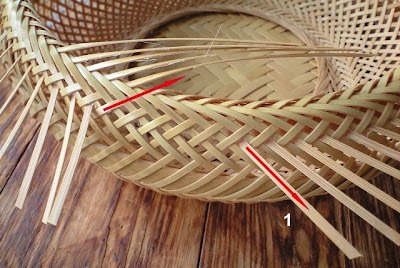
In the last post I closed by describing kata-jime, the step in which the strips are pressed together at the top to pinch the weave shut. From here the strips are interwoven to form a braided rim, called tomo-buchi (共縁), a name taken from the two characters meaning "together" and "rim." From the craftman's standpoint, the tomo-buchi is a brilliant way to make a rim because it doesn't require fashioning and attaching new bamboo material or tying such material with the more costly rattan--it's both time and cost effective (not to mention beautiful, as you will see).

The strips at this stage are comprised of two parts, those pointing leftward and those rightward. When braiding a tomo-buchi, strips pointing leftward are eventually arranged so that they overlap each other in proceeding order as the rightward-pointing strips are wrapped around them. The image above shows step 1 almost finished; the last five strips are to be wrapped around and inserted in holes in the lower weave so they stick outward. In step 2 (below), the strips are trimmed to an appropriate length and then tucked in the rim itself, ending the braid and creating a herringbone-like pattern.

With this, the body of the Teppachi is finished. All that remains is making and attaching a chikara-dake (力竹) to support the bottom side. The chikara-dake for this basket is a short, stubby piece whose material is taken from the thick-walled base-end of the madake culm. After splitting a tube into sticks, the sticks are soaked in water to soften them. The sticks are then whittled down to an appropriate thickness and their ends thinned with a kiri-dashi knife so they can fit snuggly between the wheel weave (rinko-ami, 輪弧編み) and the ajiro weave (網代編み).

History of the Teppachi Morikago
It would be a waste to leave this section on the Teppachi without touching on the basket's history. The basket was originally designed by the first Living National Treasure to be designated in the bamboo arts (竹芸), Shono Shounsai, who grew up and lived in Beppu. Besides the more obvious aesthetic beauty of the basket's design, the basket is also a technically superb product because it uses all parts of the bamboo culm. Up to this point I haven't mentioned in any depth the structure of the bamboo culm and how its structure affects its application. In essence, however, two major elements greatly affect how each section of the madake culm is used in the Teppachi: 1) distance between the nodes, and 2) thickness of the walls between the nodes. (Girth, or culm diameter, is also an important factor in bamboo crafts, but because poles are categorized according girth from the point they are cut from the forest and through all steps of distribution, attaining the appropriate diameter pole is merely a matter of choosing the right diameter when purchasing; the Teppachi uses poles that are 6 to 7 centimeters in diameter.) Starting from the ground and moving skyward, the difference between nodes starts relatively short, expands towards the middle and gradually shortens again at the branches. Wall thickness follows a general and gradual change from thick (over a centimeter) at the base to thin (a few millimeters) at the branches. For the given size Teppachi we made at school, we were able to use any sections along the culm that, including one node, were greater than 52 centimeters in length for the body strips, and 80 centimeters for the hari-dowa (abdomen ring). This makes all of the culm usable except for the bottom 2 or 3 meters. This remaining section is applied to the bottom ajiro weave (底網代), which is made of short strips without nodes, and the chikara-dake, which utilizes the meatiest base area. Thus, from one whole madake pole one could make a couple Teppachi baskets (the number depending on the basket's intended size) and be left with only a small amount of extraneous material.

(Photo by David Ottinger)

The Teppachi experienced its heyday as a local product of Beppu in the two decades between the mid-1940s to the mid-1960s. It was made and sold as a souvenir gift for tourists who came to Beppu to bathe in its countless natural hotspring baths, often staying for weeks at a time to treat various bodily ailments in a form of medical treatment called toji (湯治). Sometimes the basket was sold containing the giant Zabon citrus, also a local product, or as a two- or three-piece set, called ireko (入れ子, "inserted child"), in which incrementally smaller sizes of the same basket nested in their larger counterparts. The type of weave for the basket bottom changed depending on its size; some consisted of a mutsume-ami adaptation called mutsume-kuzushi, or a simple square weave called yotsume-ami (四つ目編み). The size we learned to make at school, size 3, sold at the time for 100 yen. What was most surprising to me was learning that the quickest craftsmen were able to make 5 sets of three-piece ireko (a total of 15 baskets) all in one day! This is a sad fact to me considering I made 5 baskets in one month. From the 1960s onward, bamboo products were increasingly replaced by the plastic variety, putting out of business a lot of Beppu basket makers who had few other items in their repertoires with which to support themselves. The subversion of bamboo crafts by plastic products was a trend that occurred throughout Japan and is a theme that pops up in almost any account of the craft's recent history. It also seems to pose a huge barrier to any future expansion of the bamboo material and craft markets.

Saturday, July 11, 2009

Teppachi Morikago: Part 2

Tuesday this past week was Tanabata--7/7, the day when lovers unite. One of the students convinced the director to let us cut a bamboo tree and decorate it--a custom that up until a few decades ago was popular but isn't so much nowadays, so I hear. (See Tanabata Story and Customs on Wikipedia.) We each decorated the bamboo with our own rectangular strip of colored paper, called tanzaku (短冊). The wish I wrote on my paper was: 腰が素直に曲がるようになりますように, which means "I hope my hips become more flexible," in reference to the pain I experience daily from sitting cross-legged and in seiza all day. Some other students also decorated it with model balloons and other papers of different shapes. It's usually customary to float the entire thing down a river once Tanabata is over, or burn it, but our bamboo was drenched by the following day's rain and was disposed of soon thereafter. The whole practice of decorating a large plant with colorful ornaments and wishing for something reminded me of Christmas.

Rinko-awase 輪弧合わせ
Back to the Teppachi. So with all three separate parts prepared and ready--two wheel weaves (輪弧編み) and one diamond twill weave (桝網代) cut into a circle--we can now form the base and walls of the bowl. Before combining the two wheels, it's actually best to first even the spacing between the strips on each wheel so that the strips on one wheel fall pleasantly in line with the space between the strips on the other wheel. Once this is done, the circular twill weave is sandwiched between the two wheels, with a heavy weight placed on all three layers to keep their centers from straying. What follows is a rationally simple but technically complicated process of interweaving two wheels (rinko-awase, "combining wheels"), which have a total of 80 strips. The first two steps are the most confusing. The first is called pea-zukuri ("making pairs", ペア作り) and the second is called pea-wake ("separating pairs", ペア分け). In the first step a strip from the bottom wheel is pulled up to meet with one of the strips on the top wheel so that each strip has a mate. On the diagram below, the blue arrow points to where a pair of strips (marked with red lines) are made. In the second step, the pairs are made to pass over one intersecting strip and then separated by weaving them under the next intersecting strips, but by staggering them (yellow arrow).

Once pairs are made and separated the rest of the weaving process is relatively simple, because at this point all 80 strips overlap each other and alternate regularly along the entire circumference. First, each strip is woven so that it passes over three intersecting strips and then goes under the fourth; this is called san-bon tobi, or san-gen tobi ("jumping three strips", 3本飛び/3間飛び). This step is repeated, and is followed by four repetitions of ni-hon tobi (2本飛び). Once these steps are completed, the strips are pressed closer together and carefully arranged so the empty holes become nicely shaped diamonds.


Hari-dowa 張り胴輪の取り付け
The six weaving steps I just described form the bottom to middle part of the bowl's body. The entire weave at this point naturally takes on a shallow funnel shape (top and bottom views shown above); it's more a plate than a bowl. Next, a belt-like loop called a hari-dowa ("abdomen ring")--similar to the inner and outer rim of the Mutsume Morikago and made the same way--is placed between the strips. This forces the strips to assume a tighter diameter, making them stand.

The strips, as you can see, weave themselves around the hari-dowa, in this case by skipping five strips (go-hon tobi, 5本飛び). The height of the hari-dowa should be the same at all points around the bowl--that is, if the strips were properly spaced before attaching it. After the hari-dowa is attached and go-hon tobi completed, the strips are woven again through two ni-hon tobi and one san-bon tobi, and the spacing evened. Finally, the shorter strips (moving diagonally from bottom right to top left) are pressed together at the top so that the spacing between them fades to zero, a procedure called kata-jime ("closing one side", 片締め). This will later become part of the bowl's rim, which I'll explain in the next post.

Saturday, June 27, 2009

Basket #2: Teppachi Morikago

In early June we started our second basket: the teppachi morikago (鉄鉢盛かご), also known as teppatsu morikago. Teppachi (or teppatsu) means "iron bowl." The name comes from the iron bowl that Buddhist monks carry to receive alms of food or money. A Google image search for 鉄鉢 shows there are a variety of dimensions and materials now associated with the word, from practically spherical bowls (including glass light fixtures!), to more squat, tray-like dishes of ceramic or lacquer. Two traits they all seem to have in common are: 1) they have soft, curved edges, and 2) the bowl's lip is slightly contracted, with the bowl's maximum circumference usually located closer to the lip than the bottom. Here's a fun image of a raccoon dog (tanuki; 狸) holding a teppachi.

Rinko Ami 輪弧編み
Teppachi morikago come in numerous sizes, all of which are made to such precise dimension standards that they nest inside one another like Russian dolls. We are making one of the medium sized bowls, which consists of 80 weaving strips (編みひご), 2.5 mm wide by 0.55 mm thick--half in width and slightly thinner than the higo we used for the mutsume morikago. In the first step, 40 higo are weaved together in what's called a rinko-ami ("wheel weave"); in this weave, each strip is layered above or below the previous strip (depending on whether your eye is moving clockwise or counter-clockwise), with all the strips interlocked in such a way that they stay together once the wheel is complete. The series is started by inserting higo one-by-one into a five-prong, makeshift tool so that each strip overlaps two other higo. Once a chain of 40 is made, the last five strips are inserted in place of the five prongs, which are then removed, completing the circle. I should note that not all rinko-ami consist of 40 higo and not all use a five-prong tool; these variables seem to change greatly depending on the desired diameter of the wheel, higo size and number, etc. The completed wheel above is one we made for practice using 29 higo. In each teppachi bowl, two wheels are placed on top of each other and interlaced from the center outward, so the 29-higo wheels were important for learning the more complicated step of combining two wheels.

Ajiro-ami 網代編み
The center of the rinko-ami--what for now is just a big gaping hole--will become the bowl's bottom, so a seperate circular piece is needed to fill it and support the bowl's contents. In this case we use twill weave or plaiting called ajiro-ami. There is an infinite variety of patterns that can be made from ajiro-ami based on how strips of different widths and colors are distributed in the weave. For our teppachi, we used undyed strips that are all the same width (7.0 mm wide by 0.6 mm thick). It just so happened that some of the bamboo I was working with had a particularly strong green hue, so I was able to cross green strips with the more ordinary ivory-colored strips, making its concentric square pattern--called masu-ajiro (桝網代)--stand out even more.

Once the strips are weaved and pressed together, a circle is drawn with a compass on the back. Wood glue is smeared along the line, enough so that once the circle is cut out its end pieces don't come undone.

In the next post I'll show how the circle twill plaiting is inserted between two wheels and how the wheels are interwoven as they climb up the walls of the bowl.

Mutsume Morikago Part 3: Final Steps

It's taken me several weeks to finally put together the last post for this basket. Sorry to keep you waiting. While I've been busy showing Caitlyn's family around Oita and taking care of other odds and ends, nearly five weeks have flown by. During those weeks we managed to finish the mutsume basket, and, as of Friday, nearly bring the second basket on our agenda to completion. I have a lot of catching up to do.

So, back to the mutsume morikago. With the masa and inner and outer rims firmly fastened with wire, it was now time to secure the entire set with a long strand of thin rattan cane.

Yamato Musubi 大和結び
The rattan we tainees use is purchased by the kilogram unit and comes from Indonesia. It's expensive--about 200 dollars per kilogram when bought as a bundle of thin cane like in the picture. We processed the rattan the same way we do bamboo higo in the latter steps, first by running it between two blades to make it an even width of 2.0 mm (a process called haba-tori, 幅取り), and then running it through a plane-like tool (called urasuki-sen, うらすき銑) to bring it to an even thickness of 0.6 mm. Easier said than done. This was my first encouter with rattan as a raw, workable material rather than as a finished product, like a chair, and it was endlessly frustrating. It's so soft compared to bamboo that attempting to shave off too much at one time runs the blade entirely through the cane, severing it--a mistake I made about 10 or 15 times. When shaving bamboo higo to a certain thickness, we try to find the sharpest part on the urasuki blade; with rattan we had to search for the dullest part, and lower the cutting angle, because it's so soft.

Rattan is probably used in basket making if for no simpler reason than that it is more flexible and less prone to cracking or breaking than bamboo when wound tightly. Brought to the dimensions of 2.0 by 0.6 mm, it really feels like soft leather string, or some synthetic material--but unlike either of these, less dependable. I found this out when tying my baskets with it. The knots in this basket are called yamato-musubi (大和結び), yamato being an ancient word for "Japan." Just as with bamboo, we wet the rattan first to make it even more flexible and to keep it from snapping when tying the knots. For me, this was the most difficult step in the entire basket. Pulling too hard when finishing each knot makes the rattan snap, and not pulling it hard enough produces a loose knot, which in this case is more worrisome aesthetically than technically because there are enough knots on the entire rim to keep it in place. Hoping to make beautifully snug nots, I must have snapped the rattan about 10 or so times, each time requiring a special grafting knot that takes even more time to complete. I had to keep telling myself that it's in fact a plant.

Outer rim ↑ Inner rim ↓
About 2.5 meters of rattan was used to tie the entire circumference. When everything goes well and the rattan doesn't snap it works it's way around the basket continuously, stopping at every other hexagon to wind around the rim twice, pass through a few of it's own loops, and move on. About 10 cm of end left from the first knot is met with the last knot and looped through to give it a truly continuous appearance. When finished tying the rattan, all the metal wires are snipped off. Another challenging part worth noting: when tied well, the two strands on the inner side lie parallel to each other and don't cross (in this case, the right knot is dangerously close to crossing and not as visually pleasing).

Ikada-dake 筏竹
Now virtually finished, the only thing missing in this basket is some support for its bottom end. With the hexagonal weaving left alone, you can probably imagine it's a bit too weak to maintain a clean shape over the long-term if made to contain, say, apples or other heavy fruit. To solve this problem, ikada-dake ("raft bamboo") are used.


Top view (before) ↑ Top view (after) ↑ Bottom view (after) ↓

Technically, this step is simple and doesn't require much explanation. Bamboo strips measuring 14.5 mm wide by 1.8 mm thick are cut to form a perfect, larger hexagon and then woven into the basket's hexagonal latticework. As in many Beppu bamboo craft items, form is prioritized alongside function, so the problem of which strips go over and which go under the ikada-dake is handled with special care, and produces a series of concentric diamonds on both sides. It's this aspect of basket making that gets the wheels in my mind spinning when I think about designing my own baskets in the future.

Saturday, May 30, 2009

大分合同新聞の記事 Article in the Oita Godo Shimbun Newspaper

 5月17日(日)朝刊の大分合同新聞に載った記事。写真をクリックすると、拡大され、読めるようになる。ネット上の大分合同新聞にも記事がアップされているので、どちらでも読める。
 This is the article that appeared in the May 17th (Sunday) morning edition of the Oita Godo Shimbun, a local newpaper that covers news in the Oita prefecture area. You can look at the article more closely by clicking on the picture. There is also a copy of the article, including a color photo, on Oita Godo's webpage. A translation of the article is available below.

Prisoner of Bamboo Crafts
Mr. Jensen, former Coordinator for International Relations
First Foreigner at Beppu’s Training Center

Oita Godo Shimbun (Morning Edition), Sunday, May 17, 2009
------------------------------------
Former Coordinator for International Relations and American native Stephen Jensen (Jonan Higashi-machi, Oita City) has been studying bamboo crafts at the Oita Prefecture Bamboo Craft and Training Support Center since April. This is the first time a foreigner has been admitted to the Center. He said enthusiastically, “I want to make all kinds of baskets. I need to work hard to get to that level.”

Mr. Jensen came to Oita Prefecture in August, 2006, and worked as an international relations coordinator until last summer. He is also a member of Sodokai, a drawing and painting group in Beppu City. Capturing bamboo as a subject for his paintings, he felt drawn to bamboo since his arrival to Japan, he says.

In October last year, students from Malaysia visited Beppu to study bamboo crafts. While working as an interpreter, Mr. Jensen watched bamboo being weaved from close up, which spurred his desire to come in touch with one of Japan’s traditional arts.

In the United States, “bamboo culture” is virtually nonexistent; it occupies little presence beyond its display as artwork in galleries. “I eventually hope to become a bridge—to help introduce Beppu’s bamboo crafts to Americans and deepen their understanding of it.”

Mr. Jensen will work for one year acquiring the basic techniques and production skills. “The most captivating thing about bamboo is its versatility. I see value in both purely aesthetic and utilitarian baskets. For now, I want to experiment with making different types.”

Trainees are currently working on making higo, the step before weaving when bamboo materials are shaped. It’s the foundation for all bamboo crafts, but keeping thickness consistent has been difficult. “Although, I have the hardest time getting used to sitting in seiza. My legs fall right to sleep.”

Shigeru Tamura, director of the Center, expressed his own expectations. “He’s been working diligently. I hope he’ll become a craftsman and carry on Beppu’s tradition.”

--------
Photo caption: Stephen Jensen, who was admitted to the Center’s Bamboo Crafts Department in April this year. “I want to try making all kinds of baskets,” he says enthusiastically.

Saturday, May 23, 2009

OBSラジオ「朝感」取材の報告 Live interview with OBS radio station

 今週の木曜日の朝、OBSラジオの荒金由希子さんがトピッカーで訓練校に取材にやってきた。打ち合わせをしてから、約4分間のインタビューに入った。生放送ということでちょっと緊張していたけど、自分の竹工芸訓練についての思いを存分に語れることが嬉しかった。話し合った詳細な内容はここでは紹介できないんだけど、大分に来たきっかけは何だったのか、どうして竹工芸訓練支援センターに入ろうと思ったのか、入って一番苦労していることは何か、卒業したらどうするか、アメリカには竹工芸はあるのか、というのが大体の流れだった。トピブロ(トピッカーのブログ)にも、私と荒金さんとの写真や、このブログへのリンクも載っているから、是非ご一読を。
 先週の日曜日朝刊の大分合同新聞(11面)にも私が初の外国人として入校したことが大きく取り上げられた(それについては近々別のポストに書くつもり)。こうやって私の入校がたくさんの人に注目されるのはすごく嬉しくて、この取材ぶり(?)も大変有難い。が、毎日の訓練においては、他の18人の訓練生もみんな一生懸命がんばっている事をお忘れなく。竹に惹かれて、遠い県外から引っ越してきている方も多数いるから、「外」という意味では一緒だと思う。故郷が国内の地方であれ、別の国であれ、竹という自然素材にぶつかりながら仲良くなり、丁寧な指導を授かりながら一緒に勉強していくという意味ではみんな基本的に同じではないだろうか?うまく言えたか分からないけど、これは私の勝手な考え。
 とにかく、インタビューの機会を与えてくれたOBSラジオ、インタビューの要請に応じた竹工芸訓練支援センターの所長や先生達、こんな騒ぎで私が迷惑を掛けている訓練生たち、の皆さんへ感謝の意を表したい。

On Thursday morning this week, Yukiko Arakane from OBS (Oita Broadcasting System) radio came to the Center to interview me. Around 9:00, I was called to the director's office for a prelimary discussion, followed by a 4-minute interview that was broadcasted live on OBS radio's Chokan (朝感) show around 9:30. (Chokan, by the way, is a play on words; it's a homophone to 朝刊, meaning "morning edition," but the show's name means "morning feelings" or "morning impressions.") It was a relatively short interview so we couldn't fit much in, but the general flow of questions went like this: what brought me to Oita in the first place, why I applied to the school, what I am struggling with most at school now, what I'll do after I graduate, and whether there are any bamboo crafts in the US. They also put up a picture and a blurb from the interview on their blog. Notice in the photo we're holding the mutsume morikago that we trainees are currently working on (I'm holding the model; Arakane-san is holding one I'm half finished). I'll translate the article for you here:

From America...
Topic Car blog, May 21, 2009 (Thursday)

Stephen, from America, was admitted to the Oita Prefecture Bamboo Craft Training and Support Center (Beppu City). Stephen became interested in bamboo crafts when he saw bamboo material being processed. Learning bamboo crafts is fun, but it's painful sitting on the wooden floor, he says. He spoke energetically about how he wants to continue working in bamboo crafts even after completing the one-year program. We all hope he'll help spread bamboo crafts in America. Everyone, please check out Stephen's blog too.

Thursday, May 21, 2009

Mutsume Morikago: Part 2

Allow me catch you up on what we've been working on in the last two weeks. After weaving the bottom of the mutsume morikago, we erected the six sides and continued the same weave using four more horizontal higo (called mawashi-higo, 回しヒゴ; meaning "circular higo"), being careful to keep all the holes on each row perfect hexagons. Once the top mawashi-higo was in place we bent all vertical higo located on the outside inward; this secures the top mawashi-higo and finishes the weave. This entire process is done with three relatively thick prong-like pieces (kari-chikara-dake ; 仮力竹; "temporary strength bamboo") inserted in the bottom, used to keep the basket from losing its shape.

From there we moved on to fashioning the parts that would make up the basket's rim. There are three: the outer rim (soto-buchi; 外縁), inner rim (uchi-buchi; 内縁) and a filler piece that fits flushly between the outer and inner rims and hides the end of the higo weaving underneath (masa; 柾) (any one know the technical term for this piece?).

The inner and outer rims we made in the same way as higo, but these were much thicker pieces--2.0 and 2.5 mm--so when it came time to bend them we used what they call a heating jig (himage-jigu, 火曲げ治具). It's basically a tiered, hollow metal tower under whicih a burner is lit. Bamboo apparently bends more easily when it is heated and retains its shape well after it cools, so this seems to be the method of choice for bending thicker bamboo into perfect circles or semi-circles. Our instructor said that back when this contraption wasn't used craftsmen would bend the bamboo around their knee and rub it back and forth to create heat through friction, thus making it more pliable. Still, it would be difficult to bend it into a perfect circle through such a process. I can't imagine how difficult the task was back then. I finished bending all ten of my rims in about 30 minutes.


After molding the rims, the ends of each rim were cut to match the exact circumference of the basket. Next, 7 cm of each end were shaved away so the two ends could overlap each other, forming a closed circle. Both outer and inner rims were adjusted this way, but only the outer rims were glued shut; the outer rim decides the absolute circumference of the basket's rim, while the inner rim is made to expand freely to fit the outer rim. The rims are then clipped temporarily onto the basket so the masa can later be inserted between them.
The masa is fashioned like a higo, but made to be thick so it fills the groove between the two rims. The masa's skin is placed on the outside to match the rims, and it's split down the middle to help make it fit smoothly along the entire circumference. The picture above shows the outer and inner rims clipped temporarily, and the picture below shows the masa fit snuggly between them, this time secured by wire twisted tightly around all three. Notice the two bumps; this is the bamboo's joint. They become staggered because of the difference their circumferences.

Wednesday, May 20, 2009

OBSラジオ番組「朝感」が訓練校に来ま~す!

 緊急なお知らせがある。明日(21日、木曜日)、OBSラジオの「朝感」という番組のアナウンサーが訓練校に取材に来ることになった。具体的な時間帯は分からないが、インタビューは生放送で、9時半ごろから始まり、5分間で終わるという。訓練校に入ったきっかけとか、入ってどう感じているか、などいろいろ訊かれるそうだ。興味ある方はぜひお聴きください。

Saturday, May 2, 2009

Basket #1: Mutsume Morikago

On Thursday this week we started work on our first basket: mutsume morikago. Mutsume, as I explained in the last post, is a hexagonal weave (me refers to the holes between the higo, so, literally, "six hole"), and morikago means a "basket [on/in which you] pile [things]," or more simply, a tray. The bottom is hexagonal in shape, almost 20 centimeters across, and each side tapers together at the top to form a circular rim.

 第一の課題作がとうとう出題された!六つ目盛籠です。先週から練習してきた六つ目編みを活かした籠で、今週の木曜日からその作業をヒゴ取りからスタートさせた。今度はこれまでの練習の時よりも遥かに多いヒゴを取るために、長さ約6メートルの2本の竹を50と90cmの長さ(節がそれぞれ一つ、二つ付いた状態)に鋸で切り、割り剥ぎの工程に入った。

We started preparing the materials for this basket by cutting 6-meter-long culms (proper term for the "trunk" of the bamboo) of dried madake bamboo into 900 and 500 mm-long segments, and proceeded with processing these into higo to be used to weave the bottom and sides. I haven't yet properly described the process of making higo, and I've been trying, unsuccessfully, to find a good pictorial explanation online somewhere, but it's basically a long process of cutting bamboo vertically into strips and thinning those strips over a series of steps to bring them to a precise and consistent width and thickness. This was my first time processing over 200 strips at a time--great practice for improving my abilities, but also probably a realistic taste of the extreme repetitiveness that bamboo basket makers experience to make as ornate baskets as they do. All day Friday I worked on the same usuhagi step, in which I tried to thin higo 1.2-1.5 millimeters thick to a goal thickness of 0.6 millimeters. It's a frustrating process--any strip with a part less than 0.55 millimeters (the final thickness for weaving) thin is worthless. Measuring my strips with electronic calipers, my higo after usuhagi wavered between .5-something and .7-something millimeters; many I had to throw out because they were too thin in places, and many I had to thin again between they were over 0.8 millimeters, too thick to take to the next step. The picture below is my workspace; it shows a pile of segments in the arawari stage, where the bamboo is split radially (what they sometimes call "chrysanthemum splitting"), before the hagi stage when the strips are thinned by removing their inner side, opposite the skin.
 今度はものすごい数のヒゴだから、例えば今まで20分ぐらいしか掛からなかった荒割り(半円に割った竹を6ミリなどの幅の棒に割る作業)の工程が2、3時間掛かった。金曜日の訓練時間もすべて薄剥ぎ(竹割り包丁で約1.4ミリの厚さに剥いだヒゴを更に薄く、0.6ミリの厚さに剥ぐ作業)の工程に使っちゃった。私の性格で言えばもともと繰り返しの多い作業には別に飽きはしないが、しかもこれは自分の腕を上達させるためにも必要な時間だったけど、200本ものヒゴを加工することがこんなに体力、手間が掛かるのは経験上知らなかった。そして何よりも、慣れない正座や胡坐で一日中座って作業するのだから、脚がしびれたり、膝も痛くなったりして、こ~れは大変と思った。剥ぎの段階で失敗が多いから、ヒゴはわざと必要以上に作っているんだけど、もっと緻密な編みの籠となると、もっともっと作らなければいけなくなる。やはり、いろんな人から聞いた通り、竹細工の職人になるまでの道程は長いな~と、竹そのものに思い知らされている感じだった。

Saturday, April 25, 2009

Making Higo and Mutsume-ami

The last two weeks of training have progressed at such a quick and tiring pace I haven't gotten around to posting much of what we've been doing. I need to find an easier way in my now-busy schedule to write posts. We're also not allowed to bring cellphones or cameras into the shop except during lunch, so as much as I want to show pictures of class or training in action, I can't. From here on out, photos of my training will generally be limited to stills of the objects we're working with or making.

Anyone familiar with bamboo baskets knows how important strips of bamboo--called "higo" (ひご、籤) in Japanese--are in their making. To sum up a technically long and sensitive process, almost all of our training since its commencement has been spent on the practice of making higo by splitting, stripping (warihagi, 割り剥ぎ) and shaving complete "tubes" of bamboo. Specifically, we've been processing yellowish, dried, Oita-grown madake bamboo into higo strips with an intended dimension of 5mm wide by 0.6 mm thick. ("Intended" because any one of my higo right now tend to range between .5 to .65 mm thick from end to end. That doesn't sound like much but a few hundredths of a millimeter has a considerable effect on a higo's flexibility and on how weavable it is. Acquiring the ability to make countless higo each with the same thickness throughout is the first step to becoming a bamboo basket maker and one that is said to take three years.) We started with bamboo without joints, because processing bamboo with joints poses a difficult and potentially dangerous hurdle for beginners. This past week we went through the same lengthy process but with longer bamboo with joints.


On Thursday and Friday we started practicing our first plaiting: mutsume ami (六つ目編み), a relatively simple hexagonal weave. In this photo, the bamboo's skin-side faces the camera. You can see the joints as dark marks that spread out radially from the center in a zigzag fashion. You can imagine in the process of weaving these higo together that if they were too thick it would be difficult to press them together into smaller hexagonal shapes (each higo bends up and down like a wave to pass through the other higo). In fact, I had difficulty shrinking the hexagonal openings to the goal width of 10mm because the higo were too thick at the joints; I had to go back and thin them by scraping out the back side with a knife.

This webpage shows step by step how to put together a mutzume-ami plaiting, in this case the end product being a pot holder.

Next week we're scheduled to process bamboo into even longer strips that include two joints and also start our first basket project, supposedly one that involves the mutsume ami plaiting.

Wednesday, April 15, 2009

入校式と訓練開始

 竹工芸の訓練は今日の時点で一週間半の時間を経過して、これまでにひご作りのほぼすべての工程を少なくとも一度ぐらいは練習しているところ。入校式はもう昔のものという感じがするが、せっかく入校して初めての日本語でのポストなので、その大分合同新聞の記事をここに載せよう。 入校式の日と翌日には書類を提出したり、竹センターの規則や今後一年間のスケジュールについての説明を聴いたり、ロッカーの鍵や道具などの貸与に時間が費やされた。それから、道具の用途と取り扱い方とか、マダケの構造、刃物の研ぎ方、などなど、レクチャーの内容は少しずつ実際の竹材の加工へと変わっていった。

一番最初の刃物を使った訓練は、切り出しナイフという約30センチの刃物を使って棒状に用意された竹を削るだけという練習だった。ついでに、削ることの繰り返しで切れなくなってきた切り出しナイフを研ぐ練習もした。また、その次の日には削るだけでなく、竹を削ってお箸を作ることに挑戦してみた。できあがった一膳のお箸からは、普通に毎日使っているお箸よりもなんというか、大切にしたい気持ち、親近さを感じた。普通のお箸は大量に生産されたものがほとんどだけど、これだけ苦労して作ると普通のものじゃなくなることを再確認できた。初めて自分で作ったお箸だった。

次のポストに今やっているひご作りについて書こうと思っているので、楽しみにしてください。

Monday, April 13, 2009

Update: Start of School and Recent Activities

After all the waiting, training finally started. On Wednesday, April 8th, the Oita Bamboo Craft Training and Support Center had it's annual opening ceremony for incoming trainees--20 in the bamboo crafts department and 29 in the nursing department (a separate occupational training program that uses the same facilities but has nothing to do with bamboo). At the ceremony, which only lasted about 45 minutes, we first sang the Japanese national anthem (I don't know it by heart so I kept silent while everyone else sang, albeit quietly, around me), then heard speeches from a string of important people: first from Shigeru Tamura, director of the Center, then from proxy speakers for Katsusada Hirose, governor of Oita prefecture, and Hiroshi Hamada, mayor of Beppu city, and then from a member of the prefectural assembly, the president of the Beppu Bamboo Products Union, and two others special guests whose positions I can't seem to remember. At the end of the ceremony, one of the bamboo trainees stood in front of the director and recited a speech promising on behalf of all the trainees our dedication to the year of work that lied ahead.


The following few hours and the following day were spent prodominantly on going over the rules of the school and the trainees' responsibilities, filling out and submitting paperwork, receiving our work clothes and locker keys and testbooks, and listening to lectures about how our daily schedule will run, among other things. By the time Friday rolled around, we were finally getting into the meat of things. We were each given ("loaned", to be precise) a box of tools--filled with a large variety of very sharp blades for cutting bamboo--and assigned cubbies to put these and other tools in. We listened to lectures on the names of our tools and a brief description of their uses, as well as an amazingly thorough explanation of the structure of madake bamboo.

Madake bamboo (pronounced "mah-DAH-kay"), by the way, is a very popular variety of bamboo used in making crafts and other bamboo art; Oita prefecture is the largest producer of madake, so, on a per-volume scale, it's very cheap compared with other materials. On Friday, we trainees propped 60 6-meter-long madake bamboo trunks outside to dry for the next week or two. Six of these trunks (for lack of a better word) together costs...wait for it...3,045 yen, or approximately 30 US dollars, which is surprising considering how much six of them weigh together. When they finish drying we'll cut them into more manageble lengths with our handsaws and then begin the process of shaping them into flexible strips to be used in baskets--a process I'm not directly familiar with yet and about which I'll describe in greater detail later.

Sunday, April 12, 2009

Ono Takashi Radio Show (English Translation)

I finally finished transcribing and translating into English the Ono Takashi radio show recording. I was hoping to make the audio available too for Japanese readers and any English-speaking readers who just want to hear what the show was like, but I'm having trouble finding a free host for such a large audio file. I'll keep working on it, but for now here's the English version. I edited the audio file, transcribed it to Japanese and translated it into easy-to-read English, so it's a simplified verson from the actual show, and not a perfect one-to-one match with the Japanese, but hopefully it's understandable and interesting. Here it is:

Takashi Ono: This week we bring you another charming guest. This is “Coca-Cola Presents: Ono Takashi Fun Fan Time,” I am your host, Takashi Ono. Please send us a message. This week's guest is here on the show for the fourth time; last time was in June of 2008. Here he is. Please introduce yourself.

Stephen: Hello. It's Stephen.

O: Haha. You’re very natural by now. How are things lately? How’s your health?

S: Haven’t caught any colds. I’m doing well.

O: When you came last year in June if seemed to me like you were still a young boy, but now you come sporting a beard and all. You know, I don’t often think of people with beards as being very sexy, but I saw you and thought, wow that’s sexy. So what do other people around you think?

S: Well, not really, they say “what an artist” and stuff like that. It’s my first time being called “sexy.”

O: Oh, your first time?! Really…

S: I’m flattered.

O: No, really, it looks good. Well then, we welcome today for the fourth time Stephen Jensen. He’s working now as a translator. Last time you came we introduced you to our audience as a Coordinator for International Relations, but your contract as a CIR ended. When did it end?

S: August, last year.

O: I see. In April, Stephen will start studying bamboo crafts. So what brought you to this…what was it…the Bamboo Craft and Training Support Center?

S: Well, the first connection came last year when, from October to November, students from Malaysia came to the Center and I worked to help with interpreting. So, during that job I watched them splitting and stripping bamboo and weaving it. I knew about bamboo crafts before, that there was such a thing [here in Oita]. But seeing it with my own eyes, I thought, wow, I’d really like to try this myself.

O: I see. So it set fire to your artistic instincts.

S: Haha, yeah.

O: So, last year in October two students from Malaysia came to this Bamboo Craft Training and Support Center, and you took care of them by interpreting for them. Then you thought you wanted to try it out for yourself. We heard from you a moment ago that you passed the screening process for the Training Support Center. Is there a test for this school?

S: Yes, there is. I first submitted my application in January. Then there was a screening examination in February. So I took that and one week later the results were out.

O: Oh, so the results are out already.

S: Well, to each of the examinees, yes.

O: On this screening examination, what kinds are things are tested?

S: There were different parts. It took maybe not a full day—about half a day. There was an academic test and then a technical test.

O: What was the academic test like?

S: With the academic test first came math problems, then…

O: Math?

S: Yes, math.

O: Is math even required? I wonder.

S: Well, yeah, if you take a look, um…

O: Today, Stephen brought a book on bamboo crafts for us to look at.

S: It’s pretty geometric, you know?

O: Yeah, I guess so. It is spatial after all. What’s the right word…calculation, or shapes. It’s all about shapes isn’t it?—looking at shapes.

S: Yeah, and some artists I hear use computers to design their work.

O: And you got a perfect score? With the math?

S: It wasn’t that bad.

O: Oh, okay. Next came the technical test, or you said there was a vocational aptitude test.

S: Right, the vocational aptitude test. That tested how many problems you can solve in about a minute.

O: How did that go? Did you do well?

S: I think so.

O: (laughs)

S: It’s actually harder than it seems.

O: It’s true, when you first take a look at bamboo crafts you think about how amazing they are, but when you look closer at all the details, it’s quite delicate, all those knots. It seems like very meticulous work to me. So you passed the test and will start this April at the Support Center as a student….

S: Uh, trainee, yes.

O: As a trainee you will start a new activity. Bamboo crafts….You say translating for the students from Malaysia was what got you interested in it. What about from the artist’s perspective, what do you think when you see bamboo crafts?

S: It’s fascinating. Let’s see…the part I find most fascinating is, for one, the material.

O: Material.

S: You harvest a plant and then process it and turn it into strips, then you weave it and dye it—it’s a kind of process that’s very interesting to me. At the start you think, I want to make a bamboo art piece that looks like this, so you have to go back to one bamboo tree, one round stick of bamboo, and turn that into certain types of strips, with certain thicknesses and lengths; it’s a process you control all by yourself. I find that interesting.

O: Huh, that makes sense. For us, the way we think, we see it only in terms of gathering your materials and assembling them. But you, Stephen, see the process of making it as starting from the bamboo plant itself, is that right?

S: Yeah, if you don’t start from there…after all, there are all kinds of things that come into play with bamboo: pliability….

O: That’s true. With this type of bamboo you can make this kind of material, but with this bamboo over here you can’t.

S: Right. There are many varieties, and they all have different patterns. Like gomachiku and torachiku bamboo…there’s a lot. Some have spots, and so on.

O: Wow. You’re a trainee, but you’re already talking like a bamboo master! What about Colorado? You’re from Colorado. Do they sell anything like bamboo crafts there?

S: I’ve never seen it.

O: Never seen it! Which means, if you take the skills you learn back with you to Colorado….

S: I’d love to show people more of Japanese culture, certainly.

O: In Colorado.

S: Well, I don’t know about Colorado per se. After going back to America I’d like to help introduce it to American people, if possible.

O: Which means….cha ching! (Makes gestures of packing lots of money into his shirt pockets.)

(Everyone laughs)

S: Perhaps.

O: No no no, you can’t do that. Artists aren’t for money, after all. But seriously, we’re really happy that you can help spread this kind of Japanese culture in America. I mean, it’s quite possible that maybe one day we’ll see “bamboo craftsman, Stephen” in magazines or somewhere in Japan, right? “…Learned bamboo crafts in Beppu.” Hmmm…You said previously that Caitlyn likes to arrange flowers. Once you learn bamboo crafts what would you like to make for her?

S: Definitely a hanakago.

O: What’s a hanakago?

S: Well, it’s a vase—like a vase. There are different kinds. Some are tall and skinny, some shallow….

O: Oh, so what we call a vase is called a hanakago in bamboo crafts, right? Something you put flowers in?

S: That’s what I’ve learned, yeah.

O: Really. Wow. A lot to look forward to. Alongside bamboo crafts, you said you will continue your activities as an artist. One activity here is “Mixed Bathing World,” hosted by BEPPU PROJECT. What is that?

S: Well, it’s a contemporary art festival that’ll be held from April to June. The festival invites artists from abroad to Beppu and has each of them choose a location and make artwork. The artwork is kind of scattered throughout the city, and viewers tour the city looking at artwork. That’s the kind of festival it is. There are also music and dance categories, or events I mean. So it’s going to be a pretty large-scale event.

O: And “Mixed Bathing World,” this will be the title?

S: Yes, that’s the title.

O: I see, so the title of the contemporary art festival is Mixed Bathing World. In other words, internationally renowned artists are brought here and asked to make artwork that can only be made in Beppu, or at a certain location in Beppu, and that artwork is exhibited.

S: Yes, it’s also called “site specific.” “Installation.”

O: And, Stephen, you’ll also be displaying work?

S: No way, I can’t. It’s…they’re all very well-known artists.

O: But Stephen, for us here, we consider you to be a very famous artist. So in what capacity, what role will you…?

S: Well, I’d like to get involved as much as possible in translation and interpreting. And do as much as I can as a volunteer. Last week we hung up posters around Oita city. In between the time I’m painting…oh, but bamboo crafts school will start in April, so pretty soon I’ll be busy.

O: You’ll be very busy. Won’t you lose most of your time to paint?

S: I will.

O: So on weekdays you’ll be a trainee and make bamboo crafts. What about weekends? Paint your pictures?

S: On weekends I’ll paint picture, if possible, and then there is also daily living expenses, like before when I mentioned my school loans. I have to pay back about 400 dollars every month, so I have to earn that money too.

O: Yeah, you were saying before how it’s a “heavy burden” for you. Ah, I see. And, you know, with painting sometimes it takes a serious amount of time to finish just one work. Today you brought for us a photo of one of your paintings. It’s really…how should I say…there’s a part of it that shows your calm, pleasant personality at the same time that we feel something powerful working beneath the surface. The moment I saw it I thought you were depicting outer space, but in fact it’s a pair of morning glories.

S: They are shaped kinda like stars, aren’t they?

O: Yeah, exactly! They spread out like stars.

S: Now that you mention it….

O: And the colors are very nice. We’re also hoping to put this photo on the show’s blog.

S: This painting I actually submitted to the city exhibition. The Oita City Exhibition is going on right now. People are welcome to….

O: Oh, that’s great. If you have a chance, Stephen Jensen’s painting is on display so we hope you go see it. Well, time to wrap this show up has come in the blink of an eye. Please take a look at our blog on the OBS homepage. We’re also attaching a link to the blog of our guest today, Stephen Jensen, so take a look at his blog too. What kinds of things are you writing on your blog?

S: Well, bamboo craft training will start in April. I’ll write about what I’m experiencing on a day-to-day basis as I work with bamboo.

O: Oh, so we can read some of your artistic thoughts as well. You’re writing this in English?

S: I’m writing in both.

O: Oh, both!

S: I want to anyway.

O: I was just thinking it’ll be good English study practice. Please take a look.

S: Please write a comment too. If you have any questions or opinions—I want my readers to say them.

O: (laughs) Yes, please “say” them. Listeners, if you can, go check out Stephen’s blog. Well then, this week we heard from Stephen Jensen. For the show’s end, let’s part with these words. Ready? One, two: See you again! Thank yooouuu.

Saturday, April 11, 2009

大野タカシの番組(日本語)

私が3月に出演した大野タカシFunFanTimeのラジオ番組の録音をやっとパソコンに打ち出すことができて、今度ここに載せることにしました。読者に音声を聞かせていただこうと思っていたのですが、ブログへの音声の載せ方がどうしても分からなくて、今後載せられるかどうかいろいろとやってみます。とりあえず、活字の方を興味のある方どうぞ読んでみてください。


大野タカシ:さあ、今週も素敵なゲストをお迎えしてお届けしていきます。コカ・コーラ・プレゼンツ「大野タカシとFunFanTime」、私、大野タカシにもお付き合いよろしく。みんなからのメッセージなどをお待ちしています、ぜひ送ってください。さあ、今週のゲストは2008年6月以来四回目の出演ということで、この方です。まずは自己紹介どぞう。

スティーブン:こんにちは。スティーブンです。

:ハッハッハ、「こんにちは。こんにちは、スティーブンです」ということで慣れてますね。最近どうですか、調子は?

:調子は風邪引かずに、まあ元気にやってます。

:昨年6月に来た時は髭がなくてですね、何となくまだ幼い青年という感じだったんですけども、今回ちょっと髭を蓄えてやって参りました。なんかね、髭を生やしてる人って、そんなにセクシーと思うことって僕はあんまりないんですよ。でも、スティーブンさんはおぉセクシーだなという風に思いましたけど。どうですか、周りからの評判は?

:いやぁ、そんなに、あのう、さっきみたいにやっぱりアーテイストだとか、それぐらいです。セクシーは初めてですね、言われるのが。

:あっ、セクシー初めて。そう~ですか。

:嬉しいです。

:いやいやいや、格好いいと思って。格好いいですよ。ということで、四回目の出演スティーブン・ジェンセンさんをお迎えしてですね、今日お届けしていきます。翻訳家として現在お活躍されておりますけれども、以前来て頂いた時は国際交流員としてご紹介させてもらいましたけども、国際交流員の任期が終わったということで、いつ終わったんですか?

:去年8月。

:去年の8月に終わられたということなんですね。4月からはですね、なんとスティーブンさんは竹工芸の研修生としてお勉強されていくということでね、この後のブロックでその辺の話をじっくりと伺っていきたいと思います。お楽しみにぃ。

(音楽、CM中略)

:さあ、今週のFunFanトークは四回目の出演ということで、もうベテランでございますよ、スティーブン・ジェンセンさんをお迎えしております。僕らもなんかこう話するのが非常に安心してというか、逆に引っ張ってもらってる感じがしますけどもね。4月からは竹工芸の研修生としてこちらで活躍していくということですけども、なぜまた竹工芸のこの訓練支援センターというところに行くようになったんですか?

:ええっと、まずきっかけは去年10月から11月にかけて、その同じセンターに来ていたマレーシアの生徒に、その通訳のために仕事をしてたんですけど。で、それで、竹を、籤(ひご)をこう割り剥ぎとか編んでるのを見たんですね。で、それ以前も知ってたんですけど、竹工芸があるのはね。でも実際に目で見て、見るとなんか、ああやっぱりこれやってみたいな~と思うようになったんですね。

:ああ、アーテイスト魂に火がついたわけですね。

:(笑)はい。

:は~、自分もちょっと作ってみたいと

:やってみたいと思って

:去年の10月に竹工芸のこの訓練支援センターにマレーシアから研修生が二人来ていたと、で、それの通訳をやっていたん、お世話をしていたんですけど、自分もちょっとチャレンジしてみたくなっちゃったと。はあ、で、その訓練支援センターに合格しましたという風にですね、なんかあのう、先ほどスティーブンさんに言っていただきましたけども、これなんか試験とかいうのがあるんですか?

:あります。あのう、まず1月に願書を出してですね。

:1月に願書を出す。

:で、2月に選考試験があるんですけど、でそれを受けて、一週間経ったらその結果が出るんですね。

:ああ、もう結果が出たと

:まあ、みんな一人一人に、受験生にですね。

:は~、その選考試験というのはどういった試験があったんですか?

:いろいろあるんですけど、まあ、丸一日じゃないけど、半日ぐらいかかるんですけど。まず筆記試験と実技試験ですね。

:筆記試験はどんなのですか?

:筆記試験はまず数学、それから

:数学?

:はい、数学

:へえ、数学が必要なんですかね、やっぱり?

:やっぱりなんか、見れば、えぇ

:今日ね、参考に本を持ってきていただいてる、竹工芸のね。

:けっこう幾何学的ですね。

:まあでも、立体的ちゃ立体的ですよね。

:それもあるから

:ああ、こういった、なんですか、計算というか、図形いわゆる図形ですよね。図形を見るというね。

:で、コンピューターを使ってデザインする人もいるらしいんですよ。

:バッチリでした、数学は?

:いや、あんまり問題なかったですね。

:あっ、そうなんですね。で、後は技術試験というか、適性試験みたいなのもあるんですか?

:適性試験がありますね。たくさんの問題をどれだけ解けるかという、まあ一分間の中で。

:あっ、そういった問題もあったと。それはどうでした、うまく行きました?

:と思いますけど。

:(笑)

:でもなんか、意外と難しいんですよ。

:まあでも竹工芸っていうのはぱっと見てあっすごいなと思いますけど、やっぱ一つ一つ細かく見るともう繊細な、ね、その網目というか、緻密なその作業なんだろうなという風に思いますけども。その試験を合格されまして、見事4月からこの支援センターでですね、研修生として

:あっ、訓練生ですね、はい。

:訓練生ということで、活動していくということですけども、竹工芸、まあそのマレーシアの研修生のその翻訳がきっかけだったということですけども、アーテイストとしてやっぱ日本の竹工芸というのはどうですか、見て?

:見て、おもしろいですね~、うん~。どういうもの、どういうところが面白いのかというとまず素材ですね。

:素材。

:その植物を採ってそれを加工して籤にして、で、編んでいって染色したりして、そういうプロセスがすごく面白いと思います。まず、こういう竹工芸の作品にしたいと思ったら、まず竹の一本、一本の丸竹に戻って、それを、ああじゃあこういう籤にしないといけないとか、こういう細さとか長さとか、だから自分でコントロールできるんですね。そういうプロセスが面白いと思います。

:はあ~、そうなんですね~。なんか僕らがやっぱ思うのは、材料を揃えてその材料をこう組み立てていく、というところしか僕ら見てないですけど、やっぱりスティーブンとかは、そのまず竹ができているというところからそのプロセスをみていくということなんですね。

:うん、見ていかないと、なんか竹も柔らかさとかいろいろ関係してくるんですね。

:確かにね。この竹だったらじゃあこの素材は作れるけども、この竹だったらちょっと無理かなというところもまず見ないといけないと。

:はい。種類がいっぱいあるし、で、それぞれ模様というか、あのう、ゴマチクとかトラチク、なんかいろいろあるんですね。で、こう、何だっけ、斑ができたりして

:はあ~、訓練生なのに、もうすでに師匠みたいなコメント。はぁ~、そうですか。コロラドはどうですか、出身がコロラドですけども、その竹細工とかというのは売ってたりとかするんですか?

:見たことないですね。

:見たことがない!ということはこれ、技術を持って帰って、コロラドで。

:ぜひ、日本の文化の発信の

:発信地にしたい、コロラドを?

:いや、コロラドかわかんないんですけど、まあ、アメリカに帰ってアメリカ人に紹介したいですね。できれば。

:はあ、これでもガッポガッポよ、お金が。ザクザクと。

(みんな爆笑)

:うんうんうん、と。(笑)

:どうかな。

:いやいやもう、そいうことできないんですよ。アーテイストお金じゃないですからね。はぁ、でもやっぱね、日本のこういった文化を本当にアメリカでも広めてもらえるというの僕らとしてはすごく嬉しいし、ね、竹細工職人スティーブンというのをもしかすると、日本の雑誌とかに今後出てくる可能性があるわけでしょう、だって。別府で学んだ竹細工と。はぁ~、で、ケイトリンさんはお花を生けるのが好きだという風に言ってましたけども、その竹細工の技術を学んだら、どういうものを作ってあげたいですか?

:花籠(はなかご)ですね。

:花籠。はなかごって何ですか?

:あのう、まあ花瓶なんです、花瓶みたいな、まあいろいろあるんですね。こう、細長いのもあるし、浅い

:あっ、いわゆる花瓶みたいなやつを、竹細工では花籠というんですね?お花を生けるやつ。

:花籠というらしいんですね、はい。

:ほ~、そうですか、ね~。これ楽しみですね~。さあ、ということで、また一曲を挟みましてですね、スティーブンさんにはまたこの後お話を伺っていきます。一曲を挟みまして、ファンファイターズのコーナーをお届けしていきま~す。

(音楽、CM中略)

:さあ、FunFanトーク後半でございます。今週はスティーブン・ジェンセンさんをお迎えしておりますけどもね。今日はなんと四回目ということで、もう我々も落ち着いてお話をできるなということですけども。まあ、でも過去のそのゲストの中でも四回出演していただいてるというのはね、非常に多いと、出場回数が多いということですけども、ね。さて、これからこのFunFanトーク後半はですね、先ほどは竹工芸の研修生というか、四月からなると、訓練生になるということでしたけども、まあアーテイスト活動というのも今後もまた続けていくということですよね。どんな活動していくかというと、このBEPPUPROJECT主催の「混浴温泉世界」と。これって何なんですか?

:これは、来月4月から6月まで開催される現代芸術フェスティバルというんですけど。別府に海外のアーテイストに来てもらって、場所選んで、そこで作品を作ってもらって、で、それぞれの作品、まあ、町の中にこう散らばってる感じで、それを回って観てもらうというフェスティバルですね。で、音楽とかダンスという部門というか、イベントもありますから、けっこう大規模なイベントになると思います。

:この混浴温泉世界というのもそのタイトルになるというと。

:はい。それがタイトルですね。

:ほぉ、現代芸術フェスティバルのタイトルがこの混浴温泉世界ということ。まあ、だからその海外の有名なアーテイストを招いて、例えば別府のその場所、その場でしか作れない作品を作って展示すると。

:サイト・スペシフィックというんですけど、はい。インスタレーション。

:ほぉ、作っていくと。で、スティーブンさんも出展したりするんですか?

:いや、できないんです。それ、そんなに、けっこう有名な方がいらっしゃるので、その

:いやいや、僕らの中ではだってスティーブンさんはかなり有名なアーテイストという風に認識してますけども。じゃ、どういう形で、役割というか。

:ええっと、まあ、できるだけ翻訳とか通訳の方に関わっていきたいんですけど、ボランテイアでもできるだけやろうとしてるんですね。先週ポスター貼りやってたんですけど、大分市内でですね。絵を描いてる合間にできるだけ、まあ、四月から竹工芸の方も始まるから、ちょっと忙しくなるんですけど。

:忙しいですね。絵を描く時間も少なくなるんじゃないですか?

:なります。

:ね。だから平日はその訓練生として竹工芸を作って、週末は?自分の好きな絵を描くとか。

:週末は絵を描いて、できれば描いて、で生活費もさっき言ったみたい学校のローンがあるから、月4万円ぐらいのお金を毎月返さないといけないんですね。だから、そのお金も稼がないといけない。

:重荷になってるという風に言っていましたけれども、へぇ~、そうなんです。でもやっぱ、そのひとつの作品を作るのにはやっぱね、絵画というのはすごい時間がかかったりとかしますけども、今日もその絵を持ってきていただいてます。非常に何というんですか、やさしいその人柄が出てる部分もありつつ、でもその奥に何か力強いものも感じるという、で僕がパッと見た時に、宇宙を描いてるのかなと思った作品が実は朝顔だったと。

:星型なんかになってるんですよね。

:そうなんですよ。星型に広がってるので。

:言われてみれば。

:このまた色合いが非常にね、素敵な色合いなので。これもまたブログにもですね、アップしたいなという風に考えてます。

:これは大分市に今出してるんですよ。あのう、大分市美展、今やってるんですけど。まあ、よかったら

:へえ、分かりました。お出展されてるということで、スティーブン・ジェンセンさんの作品もですね、ぜひね、ご覧いただきたいと思います。さあ、番組この後もまだまだ続いていきま~す。

(CM中略)

:さあ、あっという間にエンディングの時間が近づいて参りました。ブログなどもですね、公開しておりますので、ホームページもご覧ください。今日ご出演いただきましたスティーブンさんのブログもリンクしておりますのでね、アクセスしていただきたいと思いますが、スティーブンさんのブログにはどんなことを書かれてるんですか?

:ええと、4月から訓練が始まるんですけど、竹工芸の。その日々経験してる、竹工芸をやってどう感じてるかとか。

:ほぉ~、その辺のアーテイスト的なお話なども見られると。これ英語で書かれてるんですか?

:両方書いてますね。

:ああ、両方書いてると。

:書こうと思ってます。

:これはでも、英会話の、あのう、英語の勉強にもなるんじゃないかなと思いますので、ぜひね、ご覧いただきたいと思います。

:あと、書き込みもしていただきたいですね。質問とか、意見とか、ぜひ読者に述べていただきたい。

:(笑)述べていただきたいということで、ぜひ皆さんね、リスナーの皆さんもアクセスしていただきたいと思います。さあ、ということで、今週はスティーブン・ジェンセンさんにお話を伺ってきました。最後はこの言葉でお別れしましょう。行きますよ。セイノ、シー・ユー・アゲーン。ありがとうございま~す。