

Recently, I went on a three-hour drive to a mountain town in northern Miyazaki prefecture called Hinokage to visit a bamboo craftsman who lives there. His name is Hiroshima Kazuo and he's a pretty famous figure in bamboo craft circles here in Japan. Now 94 years old, Hiroshima still lives by himself, and was mentally sharp, bright, and full of humor when we talked to him that day. The picture shows me and him sitting together, with Mr. Mike Okuma from the Oita Prefectural Bamboo Craft Training and Support Center on the far right, and Ms. Keiko Hirose, a former graduate of the center, on the far left (Kazutaka Kimiyama, also a former graduate, practicing basketmaker, and online retailer through his website http://www.takekago.com/, is taking the photograph). Some bamboo craft/basket enthusiasts may already know this, but some of Hir
 oshima-san's works were exhibited at Smithsonian's Arthur M. Sackler Gallery in 1995, and featured in a handsome book published under the same title as the exhibition,
 "A Basketmaker in Rural Japan." While poring over this and other publications, we talked with Hiroshiima san about his work. Because he lives in the deep mountain valleys of the Takachiho region of rural Kyushu, all of the baskets and other items he made were of the useful sort (contrasting with contemporary Beppu-style bamboo crafts, which run the gamut from useful and attractive to purely aesthetic and sculptural). He made household and agricultural tools and containers, sieves, trays, tools for silkworms and silk production, creels (fish and eel containers), fish, crab, and eel traps, and on and on. We talked a lot about the technical aspects of his products--what types of bamboo were used for them, their dimensions, etc.---which was an invaluable experience for me as an aspiring bamboo craftsman, but he often repeated this phrase that basically meant, "there's only so much I can express with words." He has over 60 years of bamboo craft experience after all. His workshop is a long room located in the front section of his house. The wall on one side has a small door for the long bamboo culms to fit through so he can slide them back and forth when he works. And the floor is sunken where he works so he can sit on the floor without having to fold his legs, something I now hope to have when I get settled making bamboo crafts somewhere someday.
Hiroshima's works will be on display until November 23rd at the Miyazaki Prefectural Museum of Nature and History in an exhibition titled 暮らしの中の竹と木, for anyone in the area who might have an opportunity to see them. Here is a link to Hinokage town's Bamboo Crafts Museum, where you can see more pictures of Hiroshima-san and his baskets. And lastly, you can read a full article about the 1995 Smithsonian exhibition at this website if you give information about your local library.


 竹箍というと、もちろんたらい舟に限って使われているわけではなく、桶や樽にもよく見かけるもの(比較的小さい樽や桶ではねじ箍という形で)なのだが、それにも関わらず、水などを漏らさないという本来の役割がちゃんと果たせるものとしての竹箍が組める人の数は多くはないらしい。私が周囲に訪ねてみた結果、大分県内では、臼杵で樽を製作している庄司正博さんという方以外、近くに竹箍の技術を持っていらっしゃる職人さんはなかなかいないではないかということだった。
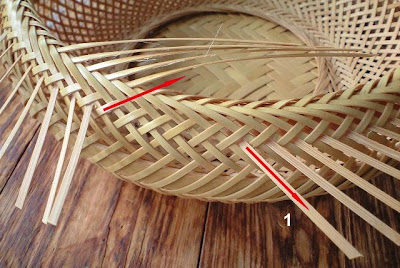 The strips at this stage are comprised of two parts, those pointing leftward and those rightward. When braiding a tomo-buchi, strips pointing leftward are eventually arranged so that they overlap each other in proceeding order as the rightward-pointing strips are wrapped around them. The image above shows step 1 almost finished; the last five strips are to be wrapped around and inserted in holes in the lower weave so they stick outward. In step 2 (below), the strips are trimmed to an appropriate length and then tucked in the rim itself, ending the braid and creating a herringbone-like pattern.
 With this, the body of the Teppachi is finished. All that remains is making and attaching a chikara-dake (力竹) to support the bottom side. The chikara-dake for this basket is a short, stubby piece whose material is taken from

 History of the Teppachi Morikago
 (Photo by David Ottinger)

 Once pairs are made and separated the rest of the weaving process is relatively simple, because at this point all 80 strips overlap each other and alternate regularly along the entire


 The completed wheel above is one we made for practice using 29 higo. In each teppachi bowl, two wheels are placed on top of each other and interlaced from the center outward, so the 29-higo wheels were important for learning the more complicated step of combining two wheels.


 Yamato Musubi 大和結び
 Outer rim ↑ Inner rim ↓
 About 2.5 meters of rattan was used to tie the entire circumference. When everything goes well and the rattan doesn't snap it works it's way around the basket continuously, stopping at every other hexagon to wind around the rim twice, pass through a few of it's own loops, and move on. About 10 cm of end left from the first knot is met with the last knot and looped through to give it a truly continuous appearance. When finished tying the rattan, all the metal wires are snipped off. Another challenging part worth noting: when tied well, the two strands on the inner side lie parallel to each other and don't cross (in this case, the right knot is dangerously close to crossing and not as visually pleasing).


 The masa is fashioned like a higo, but made to be thick so it fills the groove between the two rims. The masa's skin is placed on the outside to match the rims, and it's split down the middle to help make it fit smoothly along the entire circumference. The picture above shows the outer and inner rims clipped temporarily, and the picture below shows the masa fit snuggly between them, this time secured by wire twisted tightly around all three. Notice the two bumps; this is the bamboo's joint. They become staggered because of the difference their circumferences.


 今度はものすごい数のヒゴだから、例えば今まで20分ぐらいしか掛からなかった荒割り(半円に割った竹を6ミリなどの幅の棒に割る作業)の工程が2、3時間掛かった。金曜日の訓練時間もすべて薄剥ぎ(竹割り包丁で約1.4ミリの厚さに剥いだヒゴを更に薄く、0.6ミリの厚さに剥ぐ作業)の工程に使っちゃった。私の性格で言えばもともと繰り返しの多い作業には別に飽きはしないが、しかもこれは自分の腕を上達させるためにも必要な時間だったけど、200本ものヒゴを加工することがこんなに体力、手間が掛かるのは経験上知らなかった。そして何よりも、慣れない正座や胡坐で一日中座って作業するのだから、脚がしびれたり、膝も痛くなったりして、こ~れは大変と思った。剥ぎの段階で失敗が多いから、ヒゴはわざと必要以上に作っているんだけど、もっと緻密な編みの籠となると、もっともっと作らなければいけなくなる。やはり、いろんな人から聞いた通り、竹細工の職人になるまでの道程は長いな~と、竹そのものに思い知らされている感じだった。


 Posts


